
Agnes and Dara’s Lalela Experience
August 26, 2026
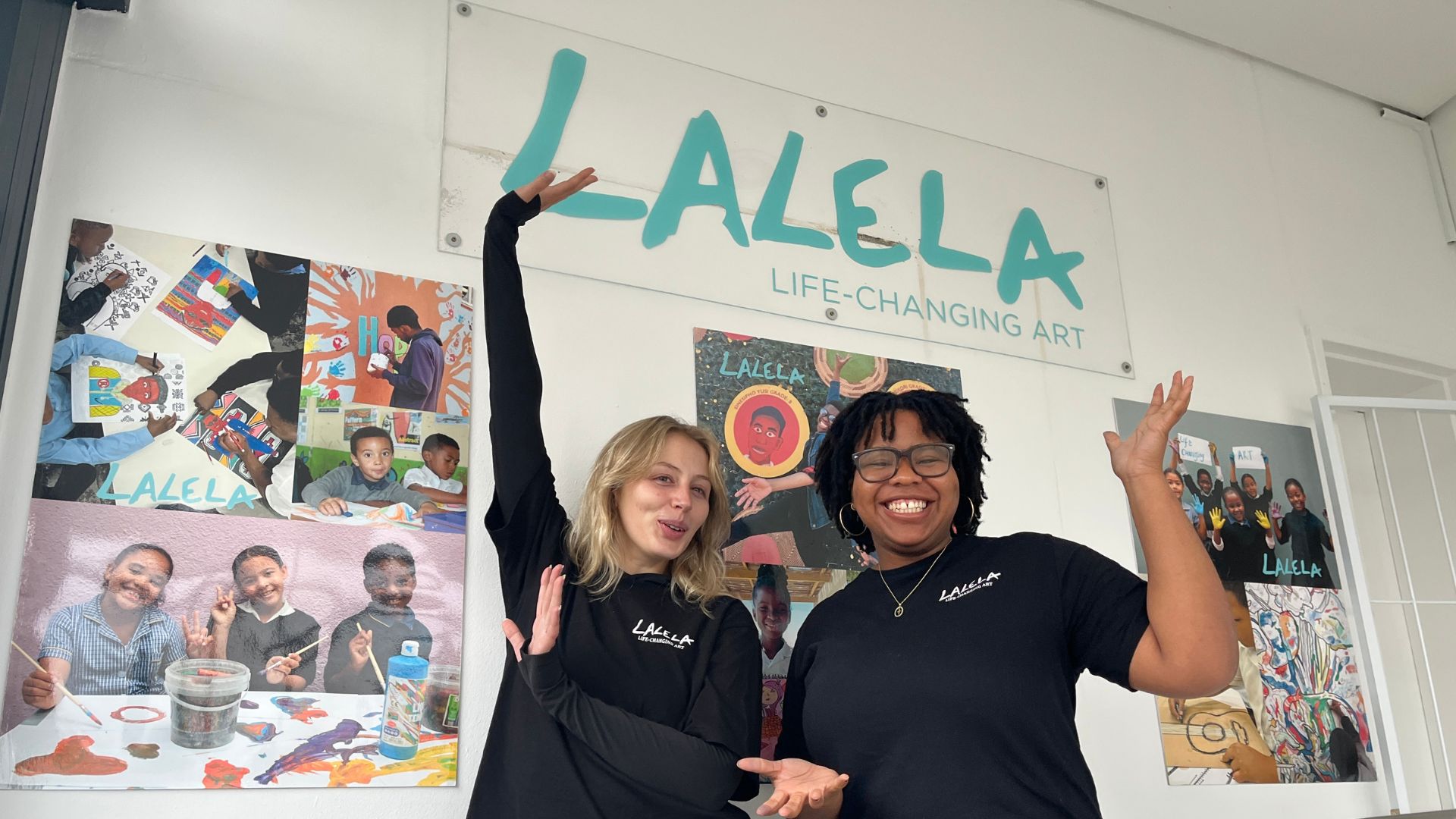
Above: Dara and Agnes outside the Lalela offices.
During their internships with Lalela, Dara Drake and Agnes Agoh worked alongside learners, facilitators and staff across programmes and age groups. Here, they reflect on their experiences, the relationships they built and what they learned during their time with Lalela.
Dara Drake
The first day I was in Cape Town, I remember looking out the window in awe as I drove down the M6 to Chapman’s Peak Drive. I seemed to be sitting right where the mountains met the sea. Seabirds cawed and I could see seals laying out on a big brown rock. It was unseasonably warm and sunny — a true California winter greeting.
One of the very first things you notice about South Africa is the beauty of the place and the kindness of the people. Everyone from Uber drivers to people at the gym to strangers sitting on the other side of a bench from me at the beach wanted to hear about my life and tell me about theirs.
But over time, the beauty of this place and the kindness of the people continued to come in conflict with a history of inequality and exclusion that was still visible. The dissonance was sometimes nauseating, mainly because much of this inequality, particularly educational inequality, was a mirror to the inequalities we see and feel in the US.
I was left with many questions — What is truth? What is reconciliation? Has it been actualized? Where does all that pain go? And most importantly, can anything be done?
Enter: Lalela
My first day working with learners was a Holiday Programme session for young learners at IY Hub in Imizamo Yethu. As I entered the playground, I could tell the kids weren’t sure what to make of me. I clearly wasn’t from here. I spoke differently; looked differently. And to be honest, I wasn’t sure what to make of them.
While I have five years of teaching experience, I’d only ever worked with high schoolers or adult learners in the US context. How could I connect with a seven-year-old? Especially one from a place I’d never been whose primary language was not one I could speak?
Once we entered the morning session, Tandi introduced me to a room full of first and second graders squirming in their seats. Tandi told them I came all the way from America and asked if they would be my friend. The class answered with an enthusiastic YES!
As the class was getting settled, a young learner named Sean approached me tentatively and asked for a plaster. I had no idea what a plaster was because in the US we call them “band-aids”, but I desperately wanted to help so I could earn some trust points. I looked back at him confused and asked how I could help.
He held out his small finger and revealed an even smaller paper cut, and suddenly I knew what to do. I sourced a box of colorful band-aids, let him pick which color he wanted, and then applied the plaster as gently as I could.
It was a quiet moment of tenderness, he gave me a hug and said thank you, and I knew I was going to be okay.
Throughout my time helping out with the Holiday Programme, Sean was one of my most dedicated learners, and he convinced many of the other learners that I was friend and not foe.
Working with the first and second graders was a blast. I spent most of my time jumping from learner to learner, responding to “TEACHER!” calls coming from across the room. Some learners wanted my advice on what colors to select or which pattern to use. Other learners needed help cutting out complex shapes or drawing faces. Still other learners requested interventions for other learners who were not sharing or being kind.
But always, I was needed. And they allowed me to join their classroom community right away.
The time flew by and by the afternoon, I had a group of about 10 children who all wanted to hold my hand at all times. We walked around the playground like that — one amorphous blob — for what felt like hours. We ate our lunches together in the sun and they told me about their favorite colors and what they like to eat for breakfast and who their best friends were. I told them about the places I’ve been and what America is like. There was a long queue for me to push them on the swings.
I was really worried about working with younger learners because I never had before and didn’t “know how”. But it was the youngest learners who stole my heart the most. The way they trusted immediately and loved so loudly; the way their personalities shone, and the way they felt no shame or felt they “should” be one way or another was beautiful.
Learning across Lalela’s classrooms
I was most focused on how I could help my learners flourish as much as I could in the short period of time I had with them. In two months, you can’t do much, but you can be an adult that shows your learners kindness, compassion, and tells them that you believe in them. You can be an adult that helps them explore their potential, or at least tell them what you love about their art.
Over the course of the internship, I ended up co-facilitating across all age groups — primary, middle, and high school learners. I split my time between two extremely skilled facilitators who knew their learners and communities extremely well — Tandi and Mark.
Learning from both of these facilitators made me a better teacher.
I was often focused on how students could “learn” the best and how I could “teach” the best — how could they know the most and remember it for as long as possible? Tandi and Mark both showed me how significant everything that goes on outside of the classroom is.
During the course of the internship, fights broke out at school and a devastating fire in Imizamo Yethu destroyed the home of one learner. They always started their sessions with this — and gave the class space to discuss those things, how they felt, and how they could support one another. While this time did take away from “scheduled programming”, the learners were much more present than if this did not happen.
Music also became very important to facilitation. I brought my speaker to class each day and allowed students to “DJ” their own music during working time. Learners got to curate their space so it felt like their own, and I also got to learn about a lot of cool new music including the genre of Amapiano.
Because I was teaching across age groups, I also learned how to adapt my facilitation based on where my learners were at in their art progressions and what they needed at that time.
Some learners just wanted space and time to create, while other learners preferred that I sit with them and act as a wall to bounce ideas off of. Some learners had many vocal questions or requests for support, and others had them too but needed me to carefully approach them and ask questions to reveal them.
One of my older learners, Lorenzo, is an extremely talented artist. On the first day I arrived at Hout Bay High to work with that age group, one of Lorenzo’s teachers entered the room while we were setting up and essentially said, “Good luck!”. He explained Lorenzo was extremely disruptive and never finished his work in class, and even shared that he didn’t think Lorenzo “should get to go to Lalela” because of his behavior.
However, at Lalela Lorenzo was never disruptive. He often worked quietly and pensively in the back of the room.
I’d often be doing rounds around the room to see what students were up to, and every time I’d pass Lorenzo’s desk his work just kept getting better and better. Mark, the primary facilitator of the class, and myself often parked at his desk and shared with him what we liked and appreciated about his work.
In his final work, on top of intricate painting, markmaking, and collaging, Lorenzo wrote: “I love my artwork because it is the best thing I can do”.
Mark and I both admired this statement displayed on top of his work as we were cleaning up after class. We both got emotional over the idea we might have been adults that made Lorenzo feel capable, talented, and full of potential.
Beyond the classroom
At Stanford, I study educational opportunity, school segregation, and the people, process, and power dynamics that either challenge or reinforce educational inequality.
In thinking about other ways I might be able to help the organization and students flourish, I knew I could use my data analysis skills.
One of my first tasks as an intern was to analyze gender proportions across learner groups. This task expanded into an analysis of attendance rates across 2026 and eventually an interactive dashboard that analyzed attrition and attendance rates from 2025–2026 across all sites in Cape Town, Johannesburg, Limpopo, and Zimbabwe.
I also had experience designing curriculum implemented across schools and universities in New York and California. I joined the curriculum design team and was able to help develop Term 4 curriculum that helped our youngest learners explore themes of bullying with Tandi.
Mark and Tandi weren’t the only Lalela team members who supported me on my journey. Everyone on the team was open to chat with me, check on me, and show me their favorite eats, places, and traditions.
Maxine introduced me to the glorious Gatsby. Siyolisi described the beauties of the Eastern Cape. Scott and Simamkele brought so much passion, intention, and talent in the way they designed curriculum for learners that I absorbed. Carol and Marilyn danced with me.
Nwabisa and Thandi G. gave me a Xhosa name, Bendi, after a busy lunch rush at the Women’s Day event — an honor I do not take lightly. After filling bowls with chicken and sausages as fast as I could, Nwabisa exclaimed, “you know your way around the kitchen! You are one of us”.
My Xhosa name means “I was” in English. I was before, and now I am one of you. To Nwabisa and Thandi — Enkosi. Thank you.
When I told colleagues that I’d be teaching art while I’d be in South Africa, they often jokingly asked, “Are you qualified to do that!?” This was because I’d only ever taught social studies, policy, or career/technical training classes. I was used to teaching my students about people, process, and policy.
What I didn’t expect is that those concepts would shine through just as brightly when I was teaching art. Art is inherently political. It’s been used as a tool time over time to push for social change.
Lalela teaches life skills through the medium of art. In this way, arts education is educational opportunity. Across age groups, lesson plans, and schools, I learned that all learners just want to be respected, trusted, and loved by the adults in the room.
Agnes Agoh
On my first day with Lalela, I sat with a high school group sewing tiny clothes from fabric scraps during the Holiday Program. Though years had passed since I last held a sewing needle, the moment reminded me of my childhood upcycling hobby.
In that classroom, where the students weren’t afraid to strike up funny conversations with me, I felt like I remembered the source of my creativity.
The students’ warm welcome also set the tone for my internship experience. However, coming from a low-income community myself, I realized this experience was about more than art, it was about learning the responsibility of becoming the mentor these students deserved.
Beyond the classroom walls
Beyond classroom walls, Lalela welcomed me into their behind the scenes work, allowing me to sit in on facilitator meetings and prepare the art materials for the upcoming term’s curriculum.
My learning continued outside the office as well as I was invited to attend retreats at the Peter Clarke Art Centre and the Zeitz MOCAA, which allowed me to connect deeply with the staff and immerse myself in Cape Town’s rich artistic environment.
Exploring the diverse range of contemporary art in those spaces was a constant reminder of the narratives Lalela was helping their students build.
Female Empowerment and Silikamva High School
For the duration of my stay, I was primarily involved with the Female Empowerment and Silikamva High School classes.
For FE, we created safe spaces to discuss what it meant to be a woman in our current world, reproductive health, and the importance of role models.
For Women’s Day, we celebrated the young girls at Bertha House by decorating tote bags filled with journals, lip gloss, bookmarks, and giving them reusable pads.
We carried this momentum on to an assembly at Silikamva High School to tackle the stigmas of period poverty.
Handing out those pads wasn’t just about providing physical resources, it was about giving them the awareness and security to exist in their classrooms with dignity.
Building trust
While those assemblies and Female Empowerment sessions tackled necessary conversations, the more general art classes at Silikamva taught me how community and deep connection can be built in the unexpected moments between projects.
I remember one afternoon while the students were painting, the shelves of a classroom cabinet suddenly collapsed, and I immediately jumped in to try to fix it so my facilitator could carry on with the class.
However, without being asked, several students dropped their artwork and knelt beside me, helping to piece the metal shelves back together.
That shared effort paved the way for everything that followed after.
Students would come up to me asking about my day or talking about theirs, they would ask to show me their art and even want to take selfies on my phone.
To me, the most rewarding part hasn’t been seeing their art flourish but feeling the growth of their trust.
Walking into class near the end of my internship, I take pride in being greeted with hugs and knowing that I’ve built a strong enough connection with some of the students for them to be able to confide in me on difficult days.
I truly appreciate how joining Lalela has brought me back to art and also exposed me to new communities.
Share this story with a friend...
DONATE TODAY
Your generosity makes it possible for Lalela’s educational arts programmes to create meaningful change that affects thousands of at-risk children in Sub-Saharan Africa.
Your generosity makes it possible for Lalela’s educational arts programmes to create meaningful change that affects thousands of at-risk children in Sub-Saharan Africa.
SUBSCRIBE TO OUR NEWSLETTER
SUBSCRIBE TO OUR NEWSLETTER